Series · OpenClaw security in-depth interpretation
OpenClaw in-depth interpretation
A series of original interpretations of issues surrounding OpenClaw security, agent runtimes, tool boundaries, and engineering governance.
Progress is stored in this browser only; without saved progress, reading starts from chapter one.
- Status
- Completed
- Difficulty
- Intermediate
- Chapters
- 10/10
- Read time
- 120 min
Guide
Series guide
Understand the reading promise, main path, and reference chapters before entering individual articles.
This series uses OpenClaw and related agent-runtime discussions as a lens for security, tool boundaries, operational risk, and engineering governance. The purpose is to help readers separate real architectural risk from hype, vendor framing, and single-incident overreaction.
Who should read this series?
- Engineers evaluating agent runtimes, tool sandboxes, and automation boundaries.
- Security reviewers who need concrete failure modes instead of generic AI safety language.
- Platform teams designing guardrails for credentials, tools, network access, and operator workflows.
Core security questions
The articles repeatedly return to five questions: what can the agent access, what can it execute, what evidence remains after an action, what boundary blocks escalation, and what operational playbook exists when the boundary fails. These questions make each incident or tool discussion comparable.
Reading order and article roles
Start with the incident-oriented chapters to see how small boundary mistakes become system risks. Continue with the contrarian and framework chapters to evaluate common claims against concrete architecture evidence. Use the later synthesis chapters as a checklist for tool firewalls, credential handling, Terraform hardening, and prompt-injection containment.
Series Path
Read by chapter
Chapter clicks store reading progress only in this browser so the series page can resume from the right entry.
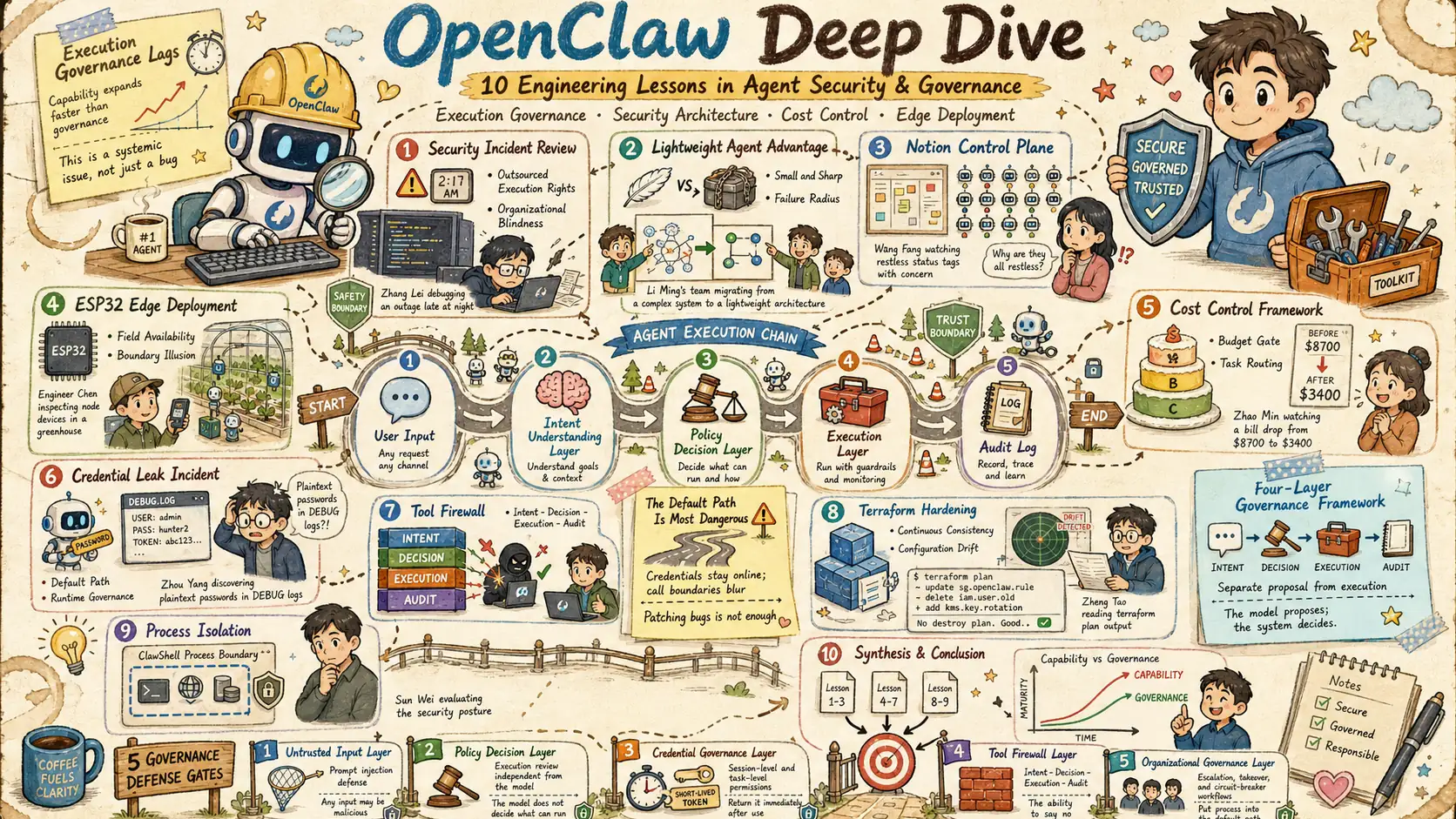
- Why do OpenClaw security incidents always happen after 'the risk is already known'? Why do OpenClaw security incidents often happen after the risk was already known? This article does not blame model behavior alone. It examines execution-rights design: when execution, audit, and rollback all live on the same path, organizational blind spots can turn controllable deviations into production incidents.
- Why is the lightweight Agent solution likely to be closer to production reality than the 'big and comprehensive' solution? This article challenges a common engineering illusion: many OpenClaw Agent stacks that appear stronger only front-load complexity into demo capability, while pushing the real cost into production failures, recovery paths, and overnight operations.
- Treat Notion as the control plane of 18 Agents. The first thing to solve is never 'automation' This article treats Notion as a control-plane question, not a UI question: when 18 OpenClaw Agents share one operating surface, does the system amplify productivity, or does it amplify scheduling noise, ambiguous state, and unclear takeover paths?
- Putting Agents on ESP32: the real risk is not performance, but boundary assumptions This article does not describe the ESP32 Edge Agent as a cool technology trial, but dismantles the four most common misunderstandings: running the board does not mean the system is usable, being offline is not just a network problem, and local success does not mean on-site maintainability. Edge deployments require new engineering assumptions.
- When OpenClaw costs get out of control, the first thing to break is never the unit price, but the judgment framework. If OpenClaw API cost control focuses only on model unit price, it usually becomes an illusion of cheapness: the monthly bill may look better for a while, while structural waste keeps accumulating in the background. This article rebuilds cost governance around budget boundaries, task layering, entry routing, and feedback loops.
- When an Agent sees a password, the exposed problem is runtime governance This incident review reframes 'the Agent saw a password' as a runtime-governance failure: credentials had become an always-online, always-visible, always-callable default capability instead of a short-lived, task-scoped resource.
- Why OpenClaw needs a tool firewall that can say no, not more prompt rules Many teams pin OpenClaw safety on prompt constraints, but the real risk ceiling is set by execution control: whether the system lets model proposals become tool execution without independent adjudication. This article proposes a four-layer governance framework of intent, adjudication, execution, and audit.
- Deploying OpenClaw to AWS is easy; keeping it safe after deployment is not When teams say they have hardened a system with Terraform, they may only have completed the starting point. IaC makes deployment repeatable, but continuous security still depends on drift detection, exception handling, and runtime governance.
- The real priority for Agent credential security is not 'where to put it', but 'who can touch it and when' Refuting an all-too-common misconception: OpenClaw credential security is complete once key escrow, encrypted storage, and rotation are in place. The real failure point is often runtime use: not where the secret is stored, but who can touch it and when.
- Looking at the three types of OpenClaw security articles together, it is not the vulnerabilities that are really revealed, but the lag in governance. When prompt injection, credential leakage, and tool firewalls are examined together, the same core contradiction becomes clear: OpenClaw's capabilities are expanding faster than execution rights management. This article synthesizes the common conclusions of three security articles.